
Opening Walk
18.00 The Circle, Gorizia
Karmina Šilec
19.00 TIR Gallery, Mostovna
Mauricio Valdés San
Emeterio (MX-SI), Alessandro Fogar (IT)
20.00 Nova Gorica City Gallery – official festival
opening
Tomaž Grom
Boštjan Kavčič, Nejc Grmek
Michele Spanghero (IT)
Tadej
Droljc
Igor Vuk
Andrej Kobal
Boštjan Čadež
Boštjan Perovšek, Brane Zorman, Paola
Korošec
Patrick K.-H. (AT)
Gal Furlan solo with iMstrument, concert
21.00 Rotunda SNG Nova Gorica
Martin Bricelj Baraga
22.00 Klub Teater, Nova Gorica –
PixxelAfter
ClockWork Voltage (DUF, Nalax Temus, Monoscarves, Shekuza) Modular sets
+ Open DJ
Set
9.30–11.30 France Bevk Public Library Nova
Gorica
Programming with micro:bit microcontrollers, workshop
Mentors: Društvo Cancel
The
workshop is free of charge and suitable for children 8+.
Registration is required at mestnagalerija@kulturnidom-ng.si.
18.00 Nova Gorica City Gallery
BBtrem (Boštjan
Perovšek, Brane Zorman)
Live performance of the composition tremolo
20.00 Small Hall of the Nova Gorica Cultural
Centre
ETCETERAL, concert
Boštjan Simon – saxophones, electronics
Marek Fakuč
– drums
Lina Rica – visuals
17.00 Nova Gorica City Gallery
OKO (CIKLON), theatrical
essay
Dorian Šilec Petek, author of the project
Sašo Grozdanov, lecturer
Andrej Kobal, concert
20.00 Small Hall of the Nova Gorica Cultural
Centre
MEHKA ČRTA, sound-spatial event
Loup Abramovici, Vid Drašler, Tomaž Grom, Samo Kutin,
Lola Mlačnik, Eduardo Raon
17.00 Guided tour of the festival exhibition venues with curator
Andrej Kobal
Registration is required at mestnagalerija@kulturnidom-ng.si.
19.00 Nova Gorica City Gallery
Samo Kutin with
iMstrument, concert
17.00 University of Nova Gorica School of
Arts
Pixel-art, workshop
Mentor: Marko Drpić
The workshop is free of charge and suitable
for students.
Registration is required at mestnagalerija@kulturnidom-ng.si.
17.00 Guided tour of the festival exhibition venues with curator
Andrej Kobal
Registration is required at mestnagalerija@kulturnidom-ng.si.
18.00 Nova Gorica City Gallery
Guided exhibition tour
19.00 Nova Gorica City Gallery
Zlatko Kaučič with
iMstrument, concert
ANDREJ KOBAL is a composer, sound artist, and developer of audiovisual systems working at the nexus of composition, spatial sound, algorithmic processes, and interactive technologies. He creates audio-visual works that connect sound, light, movement, and digital technologies, while also developing his own software tools, including GranuRise, seqMPEror, and SONONYMS, which have received international recognition, including at the MIDI Innovation Awards. He has collaborated with numerous international and domestic institutions and presented his work at festivals such as Sonic Acts, NAMM Show, Visiones Sonoras, and perAspera.
Pixxelpoint 2026 SONONYMS explores the liminal spaces of sound and image: zones where meaning is not yet fixed and perception remains open. Reality is shaped by information overload, wars, and the breakdown of shared meanings; we experience the world in a fragmented, granular way. Voices multiply, yet they often merely confirm what is already known. Sononyms opens the prospect of a different encounter: sound and image create tension through their mismatch. Liminality is not merely a transition between two points, but a state of its own – a lingering before meaning takes shape. The festival is looking for places where established explanation slips: a doubt, a cut, a rift.
In the Greek story, Parrhasius defeats Zeuxis in a painting duel with a painted curtain: Zeuxis attempts to pull back the curtain to reveal the painting, unaware that he is already looking at the painting. Acousmatic listening establishes a similar tension: we hear the sound, but its source remains unseen. The ear searches for what the eye cannot confirm. Sononyms resides within this gap: between an image that promises sound and a sound that promises an image.
Lucio Fontana opened the liminal space literally, with a blade. His slash into the canvas is an event – a slit through which the painting listens. Which canvas should be slashed today? The screen. On it, we are present through absence: scrolling down, down, and down, past scenes of destruction suffered by real people. What we need is a cut that also slices into us: one that interrupts the scroll, arrests the gaze, and makes us listen. Shock alone is not yet responsibility, but it can open a space for it. A relationship is always a liminal space – never entirely intimate, never entirely foreign.
What if music does not merely accompany an image, but creates it? Krzysztof Penderecki’s Threnody to the Victims of Hiroshima can be heard as the explosion itself: strings scream in clusters, glissandi, and noise, beyond tone and illustration. The sound summons an image that did not exist prior to listening to it – and imprints it onto the body.
And what purpose does art serve in a world saturated with everything? Let us endow it with the absurd logic of the present day and demand utility; resistance lies hidden within the very word itself. Mondrian’s trees, in their transition from recognizable form to abstraction, offer an ever-shifting perspective. Their utility resides precisely in this: opening multiple perspectives on the same thing: on a tree, on a screen, on social developments, on supposed absolute truths, and on our fellow human beings. Similarly, listening unsettles the certainty of what we see. Every new listening is a new view, and every new view opens a new ear.
In the space of this festival, this openness becomes a mode of operation. Gallery displays maintain their autonomy while simultaneously turning into spatial instruments, venues for performances, and environments activated by visitors. An exhibited work transitions into a live event; its form shifts through improvisation, intervention, and response. The visitor enters a process that is not predetermined.
What occurs between sound and image does not end when one leaves the festival venue. It persists in how we listen to and observe the everyday world, and how, in doing so, our relationship with the already familiar is transformed. The liminal spaces of sound and image invite us to persist in listening and to continue exploring that which is still emerging.
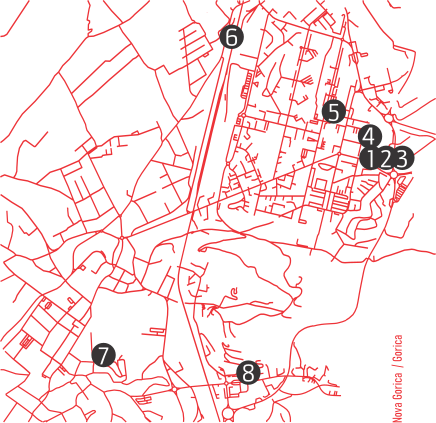
1. Nova Gorica City Gallery
Monday – Saturday
9.00–19.00
Sunday 14.00–19.00
2. Rotunda SNG Nova Gorica
Monday – Saturday
8.00–19.00
3. Klub Teater, Nova Gorica
4. France Bevk Public Library
Nova Gorica
5. Small Hall of the Nova Gorica
Cultural Centre
6. TIR Gallery – Mostovna
Saturday – Friday
17.00–20.00
Thursday 22 October
15.00–18.00
7. The Circle, Gorizia (Italy)
Monday – Saturday
16.00–18.00
Sunday 10.00–12.00
8. University of Nova Gorica
School of Arts
Kulturni dom Nova Gorica, Bevkov trg 4, 5000 Nova Gorica

Project Manager:
Pavla Jarc
Tel.: +386 5 33 540 18
mestnagalerija@kulturnidom-ng.si
Technical Director:
Tadej Hrovat
Tel.: +386 5 33 540 17
mgng@siol.net
2000, 2001, 2002, 2003, 2004, 2005, 2006, 2007, 2008, 2009, 2010, 2011, 2012, 2013, 2014, 2015, 2016, 2017, 2018, 2019, 2020, 2021, 2022, 2023, 2024, 2025
Organizer:

The festival has been made possible by:


Partners:





Sponsors:


Coproducers: